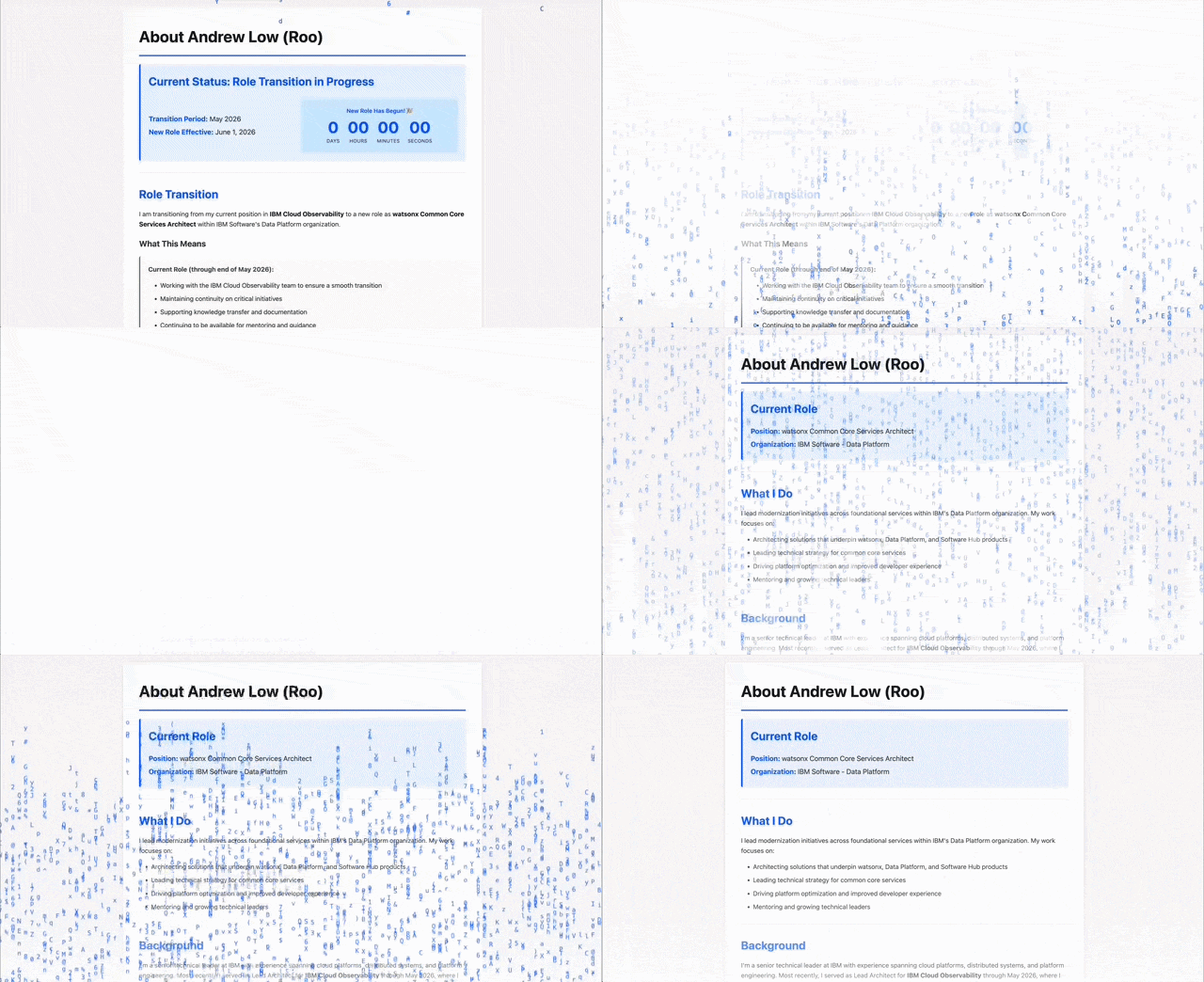
New Role: watsonx Common Core Services Architect

After a decade leading IBM Cloud’s Observability architecture, I’m taking on a new challenge as watsonx Common Core Services Architect. I’ll be driving modernization initiatives across foundational services that power watsonx, Data Platform, and Software Hub products.

This was a difficult decision: I’m incredibly proud of what the Observability team has accomplished together. But this is one of those rare opportunities that’s too good to pass up. Running towards something exciting, not away from an amazing team.

Looking forward to getting my hands dirty in the code again, learning a completely new aspect of the IBM business, and working closely with Trent Gray-Donald. Change is both scary and exciting, and this feels like exactly the right kind of challenge.

To my Observability colleagues: thank you for everything. The strong team and culture we’ve built together is something I’m deeply proud of, and knowing it will continue to thrive means I’m ready for my next chapter.

Using a OSX recovery key on a Macbook M1

Passwords are annoying, but also a critical part of your security posture. Strong passwords are important, and many organizations have policies which require you to regularly change those passwords. This will eventually lead to you changing your password – and then forgetting it – locking you out of your machine.

The Apple Macbook Pro M1 has some great hardware security, this is good to keep the bad guys out, but it’ll also keep you out if you’ve forgotten your password.

Use pass phrases. Long passwords are better passwords. Use a password manager – like 1Password or Bitwarden. When you change a key password – make sure to put aside time to practice entering that password. I find if I can spend a few hours the afternoon after I change a password – I can lock it into my muscle memory. I tend to keep it written down for those first few hours, but then make sure to securely delete/dispose of that record of the password once it’s baked into my brain/fingers.

For the first time in many years, I blew it. Thankfully my work provides a way with the serial number of the device to get a recovery key if I reach out to our IT support folks. If you don’t have this safety net – make sure you take the time to create a recovery key and then store it somewhere very safe and secure.

The key will look something like this:

RECOVERY KEY: GE62-3HW1-Y7ER-QZCT-2JJ1-6SNK

Of course, in the heat of the moment you’ll be trying to surf the web on your phone to figure out how to do these steps – and there are lots of options. Let me lay out the very simple steps you need to do to recover using this key on an M1.
  1. Boot into recovery. From a powered off state, press and hold the power button until you boot into recovery mode.
  2. Connect to a network.
  3. Open a terminal from the Utilities menu.
  4. Run the resetpassword command – follow the prompts which is where you will use that recovery key.
That’s it. Easy, but make sure you have the recovery key available to you – future you will be thankful.

30 Years

I’ve passed 20, then 25-year milestones and while it was very nice to hear from co-workers and friends on those dates it wasn’t significant. Hitting 30 years is surprisingly different for me, it is unbelievable to hit this milestone. I’m fortunate to have more than a handful of co-workers who have longer tenure than I do, some more than a decade ahead of me. It is these people that are showing me the way forward from here.

I’m proud to be a technical leader in my area. Recognized as a “Master Inventor“. Called upon to mentor and coach people both in my group and outside. I regularly work with customers, consultants, and other companies. Sometimes I even get my hands dirty with code and the work of keeping some of our cloud services going. 30 years in, and there is still plenty to keep me actively engaged and looking for the next hill to climb.

Now, 30 years counts all my full-time work. The company I started at: Object Technology International, was purchased by IBM and we were granted our tenure at that company as IBM tenure. I have many great memories of the work we did at OTI. Inside IBM we continued to make our mark in the Java space. I did a stint in Corporate helping communicate technical strategy. My most recent chapter is about building IBM Cloud. While this has all been within “one company” I’ve had a lot of different jobs over the years.

One of the things that I find attractive about computers is what they enable a single individual to accomplish. That is still true, but I’ve learned that the real magic is when you get a team of people working together to solve a problem that a has real impact. It is all my team members, past and present that I’m thankful for.

IBM continues to be a great place for me. I hope to continue to grow and learn. I’ve certainly become a better person over time, and I hope that I’ve helped others build their skills too.

None of my accomplishments would have been possible without the support of my wife and kids, to them I am forever grateful.